Welcome to Glamoursurf!

A blog with a splash of vintage swimwear, vintage fashion, news, designer profiles and all things retro.

We welcome you to shop our on-line boutique Glamoursurf, featuring everything you need from the beach to the bedroom. Glamoursurf specializes in vintage swimwear, vintage lingerie, resort wear, cover ups, swim caps and fun in the sun beach accessories. We also provide vintage swimsuit sewing patterns.

Wednesday, May 27, 2026

First There Was Wool

 First there was Wool

Prior to the middle of the twentieth century, bathing suits were typically constructed of wool or cotton.
Until rayon was introduced in the 1920s, the main available fabrics were linen, cotton, silk and wool.
Wool was considered a suitably durable material for swimsuits because of its resistance to wear and tear
and its resilience against dirt. According to an advertisement for a mohair bathing suit found in the 1908 Sears,
Roebuck Catalogue, wool was an ideal fabric for bathing costumes as it “…sheds water well and does not cling to the figure”. 

The Miracle Fiber - Lastex
About 1925, an elastic, two-way stretch textile made from Latex was introduced, called Lastex.
Lastex is a yarn that has an elastic core wound around with cotton or silk or nylon or rayon threads.
Lastex was registered as a trademark in 1931. Lastex was know as the 'miracle fiber' when it first came out.

Lastex fabrics can be made to stretch one way or two, or all ways, depending on whether the elastic thread is used only in the warp, or in both warp and weft, or in a net. There are many different Lastex fabrics –for example, batiste lastex, satin lastex, lace lastex, and a leno lastex which, though extremely strong, is very light in weight, and so is much in use for garments designed for tropical wear.

Lastex began to be used in swimwear starting in the late 30's and continuing through the very early 60's.
The smooth fitting and flattering fabric allowed swimwear and foundation  makers to produce products
that enhanced the figure, were lightweight, and fit snugly. Mabs of California, Cole, Catalina & Jantzen
were some of the first companies to use Lastex in their swimsuits. Cole went so far as to patent thier own version of Lastex called Matletex.

And Finally Nylon
Nylon's advent created a revolution in the fiber industry. Rayon and acetate had been derived from plant cellulose, but nylon was synthesized completely from petrochemicals. It established the basis for the ensuing discovery of an entire new world of manufactured fibers. DuPont began commercial production of nylon in 1939.
And then there was the war, which had most nylon manufacturing go towards Military supplies.

Hello Norma Jean


Hello Norma Jeane


Marilyn MonroeArmy photographer David Conover was one of the first photographers to take a photoshoot of Marilyn Monroe, then known as Norma Jeane. His work, including some photos of Norma Jeane, appeared regularly in such military magazines as Yank and Stars and Stripes. Norma Jeane was enthusiastic about her new vocation, and even consented to join Conover on picture-taking excursions through Southern California. After the initial Yank magazine photographic session with Conover, Norma Jeane posed for him on other occasions. As his freelance model, she was paid five dollars an hour.
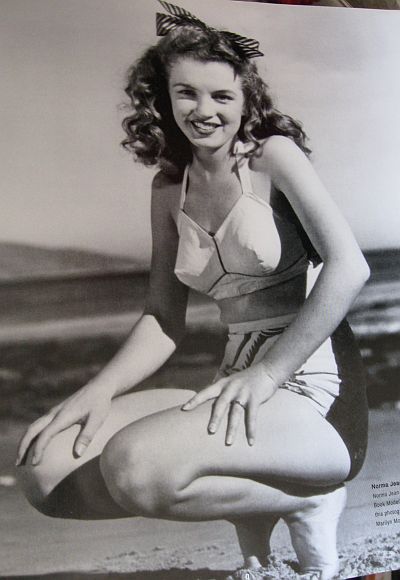


A commercial photographer named Potter Hueth became interested in Norma Jeane on a professional level after Conover showed him some of his photographs. Hueth asked Norma Jeane if she would be willing to work on "spec." That is, he would shoot some photos of her and then tout them to various magazines, but Norma Jeane would not get paid unless the photos were sold.


Some of Potter Hueth's photographs of Marilyn ended up on the desk of Emmeline Snively, head of the Blue Book Model Agency in Los Angeles. Snively sent Norma Jeane a brochure and expressed interest in using her if she was willing to take Blue Book's three-month modeling course. The photo at the left is from 1945 while Norma was at the Blue Book Modeling Agency. Norma Jeane is wearing a Catalina two piece suit.


Norma Jeane 1945

In 1946, Norma Jeane's modeling career had taken off, coinciding with the boom in exploitation magazines. Though virtually nonexistent today, these types of publications flooded the market after World War II, particularly after paper rationing ended in 1950. Several types of exploitation magazines appeared on newsstands following the war. Some were devoted to lurid crime stories, others to dimestore romance or Hollywood scandal.


A significant number were aimed at men. Contrary to what might be assumed today, the magazines did not include photographs of nudes but displayed women in bathing suits, negligees, towels, and other scanty but tasteful attire. By modern standards, the layouts are amusing, even innocent.


Because Norma Jeane was not the tall, willowy type best suited for fashion modeling, she began to make her mark in pinup magazines such as Laff,

Peek, See, Glamorous Models, Cheesecake, and U.S. Camera. A result of the popularity of the pinup during the war, these inexpensive magazines featured the best in cheesecake photography.


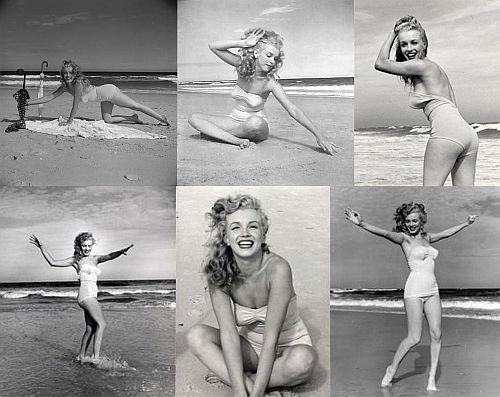
Norma Jeane posed for a number of photographers who sold their work to pinup magazines. One of the best of these photographers was André de Dienes, a fine technician gifted with a sensitive eye that enabled him to work with equal success in color and black and white.De Dienes worked with Norma Jeane from 1945 to 1949, capturing her at the peak of her modeling career. Their last session together was a series of seashore photos shot at Tobey Beach in 1949, when Norma Jeane, by that time Marilyn Monroe, was in New York City to promote one of her early films. These images are from that session.


Marilyn Monroe at Tobey Beach


Marilyn Monroe was a Jantzen model back in the days when she was known as Norma Jean Baker. In 1947 She modeled the Jantzen Double Dare and Temptation suits. The “Double Dare” was a two-piece suit with peek-a-boo cutouts on the hips. She also modeled for Catalina sportswear for advertising and publicity purposes.


In 1986 Backflips landed the rights to Marilyn Monroe for a swimwear and coverup line securing the rights through the Estate Of Marilyn Monroe. We have just aquired one of these 80's suits. It is new old stock with tags and is currently offered in our store.

80's Marilyn Monroe Swimsuit


Catalina Swimwear and the Miss America Pageant


Catalina Swimwear and the Miss America Pageant

Catalina has proved to be an ever evolving brand over the decades. Founded in 1907 by John C. Bentz as Bentz Knitting Mills, renamed Pacific Knitting Mills (1912), Catalina Knitting Mills (1928), and Catalina, from 1955. In the 1930s and 1940s the company had a symbiotic relationship with Hollywood. Warner Bros. costume designer Orry Kelly and film color consultant and makeup man Perc Westmore designed for Catalina. Starlets and stars like Ginger Rogers, Joan Crawford, Ronald Reagan, and Marilyn Monroe were photographed in Catalina sportswear for advertising and publicity purposes. Catalina's influence was also intertwined with the Miss America Beauty Pageant.

The Miss America Pageant began in 1921 as a gimmick by Atlantic City businessmen to extend the summer tourist season. Two local Atlantic City, NJ reporters suggested having a newspaper convention, in which editors could increase circulation by holding contests where readers could send in photographs of beautiful girls in bathing suits. The winners of the photographic contests would then compete against each other live in Atlantic City and the winner would be crowned "Miss America".
Miss America
In the early years of the pageant, a beauty competition of the women wearing bathing suits was the main event,
and for a while all contestants had to wear the same suits. Catalina swimwear began sponsorship of the Miss America pageants and this is when we begin to see Catalina swimwear on all contestants.

This picture shows a bevy of beauties from the 1949 Miss America swimsuit line-up. Jacque Mercer (far right) from Arizona, was crowned Miss America 1949. The pageant contestants were able to wear 'off the rack' Catalina swimsuits except that pageant suits had the flying fish logo on both hips instead of one.  This is the last year that Catalina pageant swimsuits were seen in the Miss America pageant.
1952 Miss Universe Catalina Ad


There is no 1950 Miss America winner. Since Miss America reigns for a year following her September victory, and most of that year falls into the next calendar year, in 1950, pageant officials decided to call the winner "Miss America 1951," and have followed this practice ever since.

Yolande Betbeze, Miss America 1951, refused to pose for publicity pictures while wearing a swimsuit, citing that she wanted to be recognized as a serious opera singer. In response to the dispute, Catalina swimwear, one of the Miss America sponsors since the 1940s, withdrew sponsorship of the Miss America Pageant and created the Miss USA/Universe pageants.

This is one of Catalina's 'Miss Universe' ads from 1952.


Who doesn't still hear Bert Parks singing ~ There she is Miss America....

Rudi Gernreich - A Designer before his time

 Rudi Gernreich - A Designer Before His Time

Colliers magazine Gernreich for Westwood SwimsuitRudi Gernreich was a pioneer before his time in sportswear and swimwear. Gernreich made his name with swimsuits, soon followed by belted shift dresses and simple knit styles.

Gernreich was born in Austria on August 8, 1922. He and his mother fled Hitler's growing power by emigrating to the United States following the Anschluss of 1938. After studying art and a brief stint as a professional dancer, Gernreich began working in the fashion industry in the 1950s. During the 1950s Gernreich made his mark in the fashion world by designing the first unstructured women's swimsuit, a form-fitting one-piece with no wire or other supports.

Influenced by Bauhaus functionalism, Gernreich conceived a body-based dressing with coordinated underwear, celebrating the unrestrained movement of the body based on his early involvement with Lester Horton's modern dance troupe. This interest in liberating the body from the limitations of clothing surfaced in his early swimwear designs of 1952 in which he eliminated the complicated boned and underpinned interior construction that had been obligatory in the 1950s. He revived the knitted swimsuit or "maillot" of the 1920s, which he elasticized to follow the shape of the body. These experiments were continued in his knitted tube dresses of 1953.

While he achieved modest success, it was not until the swinging 1960s that his natural avant-garde tendencies were able to surface. In the early 1960s Gernreich opened a Seventh Avenue showroom in New York where he showed his popular designs for Harmon knitwear and his own more expensive line of experimental garments. During the decade he acquired a reputation for being the most radical designer in America; his designs included the jacket with one notched and one rounded lapel, tuxedos made of white satin, and the topless monokini bathing suit of 1964, which reflected the new vogue for topless sunbathing. Gernreich cropped the swimsuit just above the waist and supported it with a V-shaped pair of thin, over-the-shoulder straps, thus exposing the breasts on either side.

Gernreich was also responsible for developing the concept of unisex, believing that as women achieved more freedom in the 1960s, male dress would emerge from the aesthetic exile into which it had been cast in the 19th century. He conceived interchangeable clothes for men and women. He also invented the thong bathing suit.

Gernreich was interested less in the details and decorations of clothes and more in how they looked in motion. In the 1950s he was designing relaxed, comfortable clothes fabricated out of wool, jersey, and other malleable materials, usually in solid colors or geometric shapes and checks. During the next decade he went on to use unusual fabrics and bold color disharmonies such as orange and blue or red and purple. It is worth noting that Rudi Gernreich persisted in using wool throughout his career. His ability to mix old and new, lighthearted and classical distinguishes all his designs.

Gernreich designed swimsuits without interior foundations for Bass from 1952-1959, and swimwear for Westwood Knitting Mills from 1955-1960. Harmon Knitwear, Inc. in Marinette, Wis. made most of Gernreich's swim-suits and all of his knitted dresses in the 60's.

50's Rudi Gernreich for Westwood SwimsuitRudi Gernreich for Westwood Swimsuit


Glamoursurf has recently acquired a mid 50's Rudi Gernreich for Westwood coral pink one piece button front wool swimsuit. It is shown here as well as above on the cover of Colliers Magazine dated June 8, 1956. You can also see this suit here in a retrospective exhibition which was held in 2001 at the Institute of Contemporary Art at the University of Pennsylvania.

Sun Worshipers

 Sun Worshipers


Germaine Monteil Sun tan oil, bronze beauty balm, tan-proof lotion, eau de cologne and dusting powder

Throughout history, the human race has had a special relationship with the sun. Primitive societies in every continent have worshiped the sun as the god that provided warmth and made the crops grow.


Helios The Sun God


Helios was believed to be the Roman God of Sun. The ancient Greeks were among the first people to adopt a tradition of sunbathing or sun tanning, which they referred to as helio therapy.  For centuries man valued the sun as a source of healing.  In other ancient societies many cultures identified skin color with status, and occasionally avoided the sun to avoid pigmentation.


Changing Attitudes of Skin Color


Women of ancient Greece and Rome used lead paints and chalks to whiten their faces. Unfortunately this beauty treatment could cause death through slow lead poisoning. By the mid-10th century, arsenic became the preferred skin whitener, once again with sometimes deadly results. During the reign of Queen Elizabeth, women painted thin blue lines of their foreheads to give their skin a translucent look, and carried parasols or wore masks whenever they ventured outdoors.


Skin color became that visible definer - one that separated working classes from the ruling classes. Pale skin belonged to the leisure upper classes, while darker skin indicated a life of outdoor labor. The paler one's skin the higher the class, and men and women went to great lengths to be pale.


Before the Industrial Revolution - bronzed bodies belonged to manual laborers. To be brown in those days was a symbol of low social class. Pale, porcelain skin was in vogue - mainly because rich people stayed indoors. But as machines began to appear, the working classes left the fields for the factories. The working class began to get paler from working indoors while the rich turned progressively browner because sporting a sun tan meant you had money and could afford a leisurely outdoor life.


The Tan Gains Popularity                                                                               1947


By the early 1920's, helio therapy was all the rage. Daily exposure to sunlight was touted as a cure for everything from acne to tuberculosis. But it wasn't until Coco Chanel came back from the Mediterranean sporting a deep golden tan, that bronzed skin become a truly desirable item. Jean Patou manufactured "Huile de Caldee" the first sunscreen in 1928. Brown and beige-tinted powders and creams were created to be brushed on the places the sun had missed. The fashion world featured clothes for women who wanted to flaunt their new tans; shoes were worn without stockings and sleeveless dresses became stylish. Bathing costumes that had covered women's legs with bloomers and stockings, now bared the leg, and swimming became an acceptable sport for women. 


By the 1930's a sun tan stood for health, wealth and style. Before long, skimpier swim wear appeared, with slim shoulder straps which could be lowered to keep an even tan. The halter was introduced into swim wear design, allowing the shoulders to be exposed for tanning.


By the 1940's, two piece bathing suits were being worn and the world would see tanned legs, exposed midriffs and bare feet in public for the first time. Coppertone suntan cream, launched in 1944, was the first consumer mass-produced product. Pinups images became popular featuring tanned women in two-piece bathing suits. Stocking manufacturers also began using 'suntan' as a coined name for stocking colors. Then, in the 1960's the sun lamp brought the Tenerife tan to your living room - even in the middle of winter. In the 1970's the thong and the tan thru swimsuits were introduced and a suntan was virtually compulsory for any stylish woman. Models were photographed with tans in summer issues of the top fashion magazines, the darker the better. Tanning lotions were all about getting darker, with the idea of sun-protection low down on the list of prerequisites. The 1980's heralded in a fitness craze. Bodybuilders began to use tanning beds, so not to have any tan lines on the body. Spray on tans and self tanning creams were also popular.


1972 CoppertoneThroughout the 70's and 80's, the fashion press promoted the sun tan as something to make you look and feel healthier and younger, in the face of a growing body of scientific evidence that it not only leads to deeper-etched wrinkles, but reduces life expectancy too. Increasing awareness of the link between exposure to the sun and skin cancer crept in slowly - aided by growing concern over damage to the ozone layer. It wasn’t until around 1972, that labeling of the sun protection factor, or SPF, was introduced in the U.S. In 1979, the American Food and Drug Administration (FDA) declared that wearing sunscreen could help prevent skin cancer. In 1980, Coppertone developed the first UVA/UVB sunscreen.


Today, people continue to tan, both indoors and out.  Though there are many more safety precautions regarding sun exposure, bronzed skin is still preferred and achieved by many.  Sun block is recommended for any amount of time spent out in the sun but you can still get a tan while you’re wearing it. 


We all need some sun exposure; it's our primary source of vitamin D, which helps us absorb calcium for stronger, healthier bones. But it doesn't take much time in the sun for most people to get the vitamin D they need.


Finally, if you choose to go out in the sun:


  • Use sun block rather than sunscreen. Sunblock lies on top of the skin rather than getting absorbed by it.

  • Don't use micronised titanium products. Smaller particles of titanium tend to enter the skin and cause damage. Stick with the un-micronised products.

  • Use broad spectrum sunblocks.

  • Use sunblock if exposure to the sun is going to be in excess of 20 minutes.

  • Use sunblock on cloudy days as well: 80% of UV rays come though in spite of the clouds.

  • Apply sunblock 30 minutes before sun exposure, reapplying every two hours. Reapply more often if swimming or perspiring excessively. Ensure that all exposed portions of the body are well covered.

  • Eat for sun protection: load up on natural anti-oxidants in your diet. Include fresh berries, green tea, spirulina and as many other natural anti-oxidants as you can.

  • Cover up in the sun: parasols, hats and glasses will afford lots of protection.

Swimwear Designers

 SWIM WEAR DESIGNERS & THE HOLLYWOOD CONNECTION


Throughout the historical time line of the swim wear industry there are some famous designers who played a part it the evolution of it's growth. Hollywood also had a starring role by greatly influencing people's awareness of style and ideas of glamour in swim wear.


Swim Wear Designers

Designers of swim wear fashions are an infamous set of icons. Some came to the industry from a personal interest in form and function while others came from the Hollywood studios. Family connections also played a role.


In 1937 Rose Marie Reid began to design and sew her own swimsuits. Reid was a passionate swimmer and was dissatisfied with the prevailing styles of the time.
In her first year of business she grossed $10,000. Her line of one piece suits featured shirring and draping typically associated with evening gowns. Emilio Pucci designed for Rose Marie Reid in the 1950's with color block Poncho's, sandals and beach caps.


In the 1940s Catalina hired several of Hollywood’s most famous designers to work on designs for them headed up by none other than Mary Ann DeWeese. These designers included Milo Anderson and Orry Kelly from Warner Brothers, Edith Head from Paramount and Howard Schoup from MGM. DeWeese is credited with innovations in the use of texture, including jacquard knits and appliquĂ©d stretch cottons. She also introduced "sweetheart' swimsuits and matching sportswear for men and women. DeWeese left Catalina during the 1950's to form her own company, DeWeese Designs. In 1960 she designed diving suits for the US Olympic team. After DeWeese left Catalina, Catalina hired a number of designers, most notably Bettina Jaynes.


Elizabeth Stewart was the daughter of Catalina's founder. In 1955 she launched Elizabeth Stewart Swim wear in Los Angeles with her husband and two brothers. Hollywood costumer and couturier Howard Greer designed for Caltex featuring his 'molded torso' line. Tina Lesser had her own clothing business in the early 50's, Tina Leser Originals,but also entered into a swim wear design contract with GABAR which lasted for many years.


Cole was working with designer Margit Felligi who joined Cole in 1936 and maintained her design leadership for the company for the next thirty-six years. Fred Cole was a product of Hollywood having been a silent movie star in the 20’s before entering the swim wear industry, via West Coast Knitting Mills which was owned by his parents. Cole used his Hollywood contacts and

had contracted with Esther Williams to promote his bathing suits in advertisements. Cole had hoped to get screen credits for other suits worn by Williams in a variety of movies including Neptunes Daughter (1949), Skirts Ahoy (1952, and Dangerous when Wet (1953), but MGM was not in agreement. Cole also contracted with Christian Dior to design his one and only swim wear line which debuted in 1955.


In the early 1960's Rudi Gernreich designed swim wear that was produced by Westwood Knitting Mills and later by Harmon Knits. Anne Cole has stated that she had discouraged Gernreich from working as a free lance designer for her father in the early 60's. "It was in early 1960 that my father made his first trip to Tahiti, and he arranged to put Rudi in charge of the collection for the coming season. I knew Rudi was brilliant, but I also knew it was because he was defying conventional fashion. His swim wear was clean and simple. I was afraid we'd ruin him! I mean, he'd loose his design eye if we had him turn out the type of structured suits we were selling." In 1982 Ann Cole began designing swim wear that was launched as the Cole Collection.

Textile Designers

Textile designers also played a role in working with the swim wear designers to create the latest fashions for the swim wear industry. In the mid 1940's, Louella Ballerino designed beach clothes for Jantzen. Many of these were created from Bates fabrics which took it's inspiration from Hawaii, Polynesia and Africa. Elza Sunderland was a pioneer of fine fabrics in the 1940's & 1950's. She saw potential for producing printed rayon, acetate and Lastex, and was the first to design printed terrycloth. Her fabrics were a perfect match for designers in the sportswear industry. As one of the first textile designers to understand the potential of the elasticized miracle fabrics that were so vital to swim wear, she worked with Margit Felligi for Cole, Mary Ann DeWeese for Catalina and Rose Marie Reid. She retired in 1955. Margit Felligi patented the Maletex process for Cole, which was Cole's version of Lastex. She also was the first to use Helanca Nylon for swim wear in 1954. Margit also worked closely with Christian Dior when he designed for Cole.

Two Piece Swimsuit Evolution

 The Two Piece Swimsuit Evolution


First Sports Illustrated CoverAlthough the bikini became popular in Europe in the 1940's, it didn't make a real splash in the United States until the 1960's. A couple of significant regulations in the United States kept the two piece or the bikini from gaining momentum.


The Motion Picture Production Code of 1930, known as the Hays Code or Hays Production Code, prohibited stars from "indecent or undue exposure." Exposure of the breasts, navel, and inner thighs and all undue depiction of flesh was prohibited in an effort to present only a correct standard of life on film. The first actual bathing suits that exposed the midriff would not be seen until the mid 1930’s.


This style change in swimwear was first accomplished by providing the traditional maillot with creatively shaped cutouts. To expose even more skin, X shaped straps were adapted to open the suit’s back. This innovation was subsequently followed by the maillot being divided into two distinct pieces. The waistline however remained high, always above the navel.


Then in 1942, the US government made the L-85 order, issued by the War Production Board, requiring the amount of fabric in clothing be reduced. Wool, silk, rubber, leather, nylon were all needed for the war effort. One requirement was that the amount of fabric in female swimsuits be reduced 10%, and the fabric covering the midriff increasingly became a wartime casualty.  Two-piece swimsuits had been fashionable in Europe throughout the 1930's, the L-85 order helped that trend to become fashionable in the states.


The two-piece would evolve into a just handful of designs without a single one of them dominating. Tops took on the form of bras, string halters, and bandeau's, while bottoms were typically in the form of skirted panties, shorts, or sarongs. Another adaptation was a new skirt less panty bottom but it would not find much of an audience outside of Europe at this time.


At the War’s end while Americans were still trying to accept the high waisted two-piece, a swimsuit that exposed the stomach was introduced in Cannes under the name L’atome. Two weeks later on July 18, 1946 the French designer Louis Reard introduced an even skimpier swimsuit. He also took a clue from the new age ushered in by the atomic bomb blast at a Marshal Island atoll called Bikini and named his creation after it.


By the late 1950’s American movie stars began posing off screen for magazines and postcards in bikinis they could not wear in films. The movie industry began suffering from low film attendance as their products grew more out of sync with cultural demands. Eventually they they replaced the Hayes code with a movie rating code system which had popular support. Stars like Brigitte Bardot in "…And God Created Woman" (1956) helped kick off the trend, while Annette Funicello movies like "Bikini Beach" (1964) and "How to Stuff a Wild Bikini" (1965) helped make the bikini more popular to the masses. In 1967 Racquel Welch appeared in "One Million Years B.C." clad entirely in what would pass for a bikini. The first Sports Illustrated swimsuit edition in 1964 sealed the deal with Babette March in a white bikini. With more exposure in movies and a general shifting of morals during the 1960’s the bikini would finally make its way onto public beaches in the United States. The Hayes commission however still had a hold over television and they would prevent the first woman’s navel from being seen on screen until 1975.


1940s Two piece satin floral swimsuit


Alfred Shaheen - Master Printer


Alfred Shaheen Playsuit

Alfred Shaheen, the son of Hawaiian custom clothing makers George and Mary Shaheen, was born in 1922 in New Jersey. Alfred Shaheen is legendary for his fashionable creations of Hawaiian Garments and fabric textiles from the 1950’s through the 1980’s. Alfred Shaheen designed and manufactured fabrics and clothing for over 40 years and Shaheen’s pieces are among the most prized in vintage fashion collections. His earliest labels include Alfred Shaheen, Shaheen’s of Honolulu, Surf ‘n Sand and Kiilani. Shaheen is best known and recognized for sarong dresses, halter full skirt dresses, swimwear and Aloha Shirts.

In 1953 Shaheen built his own factory in Hawaii to produce the textiles and hand screen prints that would make up the majority of his aloha shirts, dresses and swimsuits. All screening was done by hand, and workers were told to force more ink into the shirt fabric to enrich the colors. Shaheen fabric usually had three- to five-color designs, which were part of a library of more than 1,000 dye colors. Shaheen’s textile designs and fabrics are legendary and were inspired by Hawaii, the South Pacific and Asia. Shaheen was the most creative and prolific of all of the Hawaiian manufacturers in the heyday of ‘50s and ‘60s fashion. Shaheen’s vision, inventiveness, engineering brilliance and unreserved commitment to authenticity and excellence earned him Hawaii’s Lifetime Achievement Award in July of 2001.

Because Shaheen was the only Hawaiian manufacturer to print his own fabric, he was able to create and distribute exclusive exotic clothing for many national top retailers. By the mid-1950s, Shaheen’s clothing was sold in such stores as Bergdorf Goodman and Marshall Field & Company and spotlighted in such national magazines as Vogue, Mademoiselle and Town & Country.


1950s Alfred Shaheen Sarong Wrap Wiggle Dress

In the early-1960s, Shaheen opened his own chain of retail stores in Hawaii and established Alfred Shaheen departments in national department stores. The exotic beauty of Shaheen clothing held no cultural boundaries, and all cultures were celebrated in Shaheen’s “East Meets West” departments, which opened in such stores as Bullocks, Macy’s and Scruggs Vandervoort Barney. It is widely believed that Shaheen popularized the cultural influence in fashion that exists today.


Camille Shaheen, Alfreds daughter, has carried on the marketing and promotion of her fathers legendary collections. Sadly Alfred Shaheen passed on December 22nd, 2008 from complications from Diabetes. He was 86 years old.


The Versatile Sarong


Dorothy Lamour

Dorothy Lamour - Sarong Girl


Dorothy's first two films in 1936, "The Stars Can't Be Wrong" and "The Jungle Princess," were where she first wore her trademark sarong. Dorothy Lamour popularized the sarong during WWII and the image of her in a sarong would follow her in her career for quite a while. You can read more about Dorothy Lamours career with sarongs here.

The Versatile Sarong


The definitive beach-wrap is known as the pareo from Tahiti to Hawaii, the lunghee in India, a Surong in the Philippines, in India a similar garment is named Sri and in Africa they call it a Kanga. In ancient times of Rome and Greece it was named a "Toga". Pareo is the Tahitian name for wrap-over skirt (pareu), today it is worn as a beach cover up and can be worn in a multitude of different ways.


By folding, wrapping, twisting and tying the sarong in various forms, a sarong can be worn in many ways. From a wrap-around dress or skirt, to a jacket, scarf or turban. There are around 15 different methods of wearing one. The pareo or sarong also morphs into a beach towel, for lying on the beach or a light sheet to protect you from the sun when resting.


How to wrap a sarong


Always comfortable and discreet, its secret lies in the fact that it works for any figure, and is easy to throw on. It can also be worn around the house or used as a long skirt for the evenings. Very few other fashion pieces are so versatile. A sarong permits good air circulation around the legs and is thus far more comfortable to wear than long pants.

The Evolution of Beach Footwear

 The bathing machine in Edwardian times allowed people to be covered while at the seaside, thereby allowing people to wade in the surf while maintaining seaside etiquette. In the early 1900's women were required by law to be covered from head to toe for 'bathing'. Most bathing costumes were made of wool at that time. Many sociological and technological advancements helped to change the modest styles seen at the beach. Stockings were required to be worn with beach shoes and began to be rolled down showing more leg.


The bathing machine in Edwardian times allowed people to be covered while at the seaside, thereby allowing people to wade in the surf while maintaining seaside etiquette. In the early 1900's women were required by law to be covered from head to toe for 'bathing'. Most bathing costumes were made of wool at that time. Many sociological and technological advancements helped to change the modest styles seen at the beach. Stockings were required to be worn with beach shoes and began to be rolled down showing more leg.

When the first World War broke out women took up jobs in factories to support the war and then in the 1920s women gained the right to vote. Bathing wasn't called swimming until the early 1920s when Jantzen started using the term 'swimsuit' in their advertising and promotional materials. Helio therapy was all the rage and sun worshiping became popular. In the mid twenties swimming became recognized as an acceptable form of exercise and womens suits began to show the influence.

1940s


Lastex, the miracle yarn was invented in 1931 and nylon came along in 1935 allowing more form fitting fabric made into swim wear.

In the 1940s it was very popular to see movie stars and models wearing platform shoes at the beach thereby showing off the curves of a woman. In the 1950's and 60's beauty pageants showed women in high spike heels, further accenting the shapely leg attributes.

Sandals, flip flops and thongs came into vogue in the 1960's and remained popular through the 1970's. Birkenstock's also were popular during this time.

Beach shoes and jellies appeared in the 1980's. Today water shoes help protect the feet in the surf from the ravages of coral and rocks.


1960s


Swimwear Resource Roundup

 Swimwear Resource Roundup

vintage swimsuitI thought it would be fun to create a bathing suit resource roundup, a list of some of our on line colleagues and friends who have some wonderful swimwear sections chock full of information on vintage swimwear or just some beautiful eye candy.

First off is Fuzzy Lizzie; Lizzie has put together a very interesting tour of vintage swimwear from her personal collection. She is also a vintage sportswear aficionado and has a wealth of information and topical articles here.

Next is Angie from Capricorn Vintage. Angie has just recently launched her website and has included a virtual swimsuit museum from some of her past sales. Yummy, yummy!

The Vintage Fashion Guild gives us a nice article on the history of the swimsuit called 'In the Swim'. The VFG also has a comprehensive label directory
which includes swimsuit brands.

Bikini Science presents us with a history of the bikini via a virtual time machine.


Galbreath has plenty of pretty pin up pictures of stars in swimwear. Love this site!

Roselyn Hsueh gives us the history of the bathing suit.

On to men's swimwear, David Claudon has put together a fabulous resource on the history of men's swimwear which can be found here.

April Ainsworth from the Vintage Vixen has published a lovely bio on Rose Marie Reid complete with pictures.

Next is Jessica from My Vintage Vogue. She has a wonderful photo set on her website of vintage swimwear.

Collectors Weekly has just published an interview with me where I talk about vintage swimwear.

And yup, then there's Glamoursurf. We have a label directory, a swimwear time line, many articles on vintage swimwear, and a marvelous selection of vintage swimsuits for men, women and children you to choose from.

Louella Ballerino for Jantzen

 Louella Ballerino for Jantzen

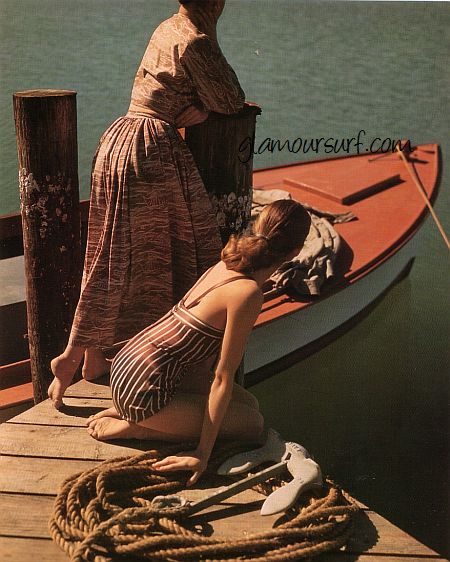
Another fabulous picture taken by Louise Dahl Wolfe in 1947. We're a big fan of Louise's work here at Glamoursurf! The swimsuit is by Louella Ballerino, designed for Jantzen.

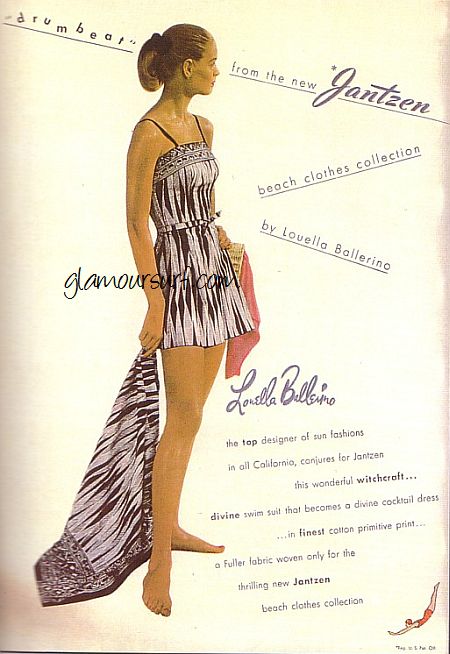
In the mid 1940s Louella Ballerino designed beach clothes for Jantzen. A major element of this outstanding collection lay in the custom prints she ordered from Bates Fabrics with inspiration from Hawaii, Africa and Polynesia.1947 Jantzen Candy Cane ad. Note the addition of the skirt and bustle. Brilliant!

1947 Drumbeat ad for Jantzen.

In the Carte Blanche design, Ballerino paired a bra and top with a wrap around skirt or shorts (not shown). Louella Ballerino graduated from the University of Southern California with a degree in art and art history. After school she married and had two children. She was forced to find work after the stock market crash and took a position at a custom dressmaking house and went to night school to study various aspects of fashion and then began teaching. At the same time, she worked in a shop where she occasionally sold her own designs and in 1938 she went into business for herself. Her first major success was a peasant dress of rough crewel embroidered with bright wool Tonga figures. Louella was and advocate of the 'peasant look' that was in sharp contrast to the tailored silhouette of the war years. She based her collections on styles and forms of decoration in Dutch, Aztec, Russian, Norwegian, Polish, Mayan, Chinese, Native American and South American costume and textiles. She usually employed boldly patterned materials, such as large scale prints and wide, bright stripes.
 Ballerino is shown approving a sea fern pattern by Bates Fabrics in this advertisement from 1946. Ballerino is credited with adapting the peasant apron and dirndl skirt for street wear, decades before the craze for peasant dressing came to America in the 1960s. She was also one of the first to design mother-daughter outfits in the postwar years.

Margit Felligi and Cole of California

 Margit Felligi & Cole of California


1950s Jantzen Novelty Print Swimsuit

Have you heard of Margit Felligi? Have you heard of Cole of California? Fred Cole was a silent film actor in the 1920s. His parents, Edith and Morris Cohn, were
the children of blue jean garment manufacturers (the Boss label owned by grandfather Cohn who changed his name to Cole). Fred gave up acting and persuaded his parents to start a swimwear line in their 'West Coast Knitting Mills' company. On
May 15, 1925, the mills swimwear division opened. The original line of knitted socks and long johns quickly diminished in favor of swimwear production and on January15, 1941 the company name was changed to Cole of California. Cole wanted to bring Hollywood glamour to the swimwear business.

Ok, so who is Margit?

Cole hired Margit Felligi as head designer from 1936 - 1972. Margit had been designing for Hollywood already and she brought many innovations to the table.

Felligi had developed a “Matletex process,” which allowed any natural fiber fabric, primarily cotton, to be shirred on rubber based Lastex thread. This process allowed Felligi to manipulate the style lines of her swimsuit designs without sacrificing a close fit. Felligi’s combination of distinct patterns, vibrant colors, and unusual design lines caught the eye of both film stars and average women.

Felligi as also responsible for designing the first side laced swimsuit called the "Swoon Suit", dubbed in honor of the young Frank Sinatra. The suit was offered in one and two piece styles form the same silk Cole was stitching into parachutes for the war effort. It's side lacing was not only sexy, it served to give silk the figure controlling characteristics of a rubber girdle. It was one of the few styles produced by Cole and designed by Felligi during the war years.

1944 Cole of California Swoon Suit


Felligi had an eye for the shock value of unusual fabrics that often seemed more suitable to the ballroom than the beach. She adapted luxury fabrics like velvet and lame, and discovered how to inset rhinestones so that they wouldn't degrade in the water.

"Women no longer should feel undressed in a bathing suit," says Margit Fellegi, designer for Cole. "After all, more and more social functions are centered around swimming pools and beach clubs. I try to make a woman feel lovely and elegant without making her aware of how naked she is."

Margit Fellegi - 1965

Cole's Hollywood connection would become the firms distinctive approach to beachwear. Through the following decades, the relationship between the manufacturer and Hollywood costume designers would only grow stronger with Cole crafting suits for film stars and cinema costumers designing suits for Cole.


Cole of California, Margit Felligi Recent Acquisition

We've recently launched this black velvet late 1940s swimsuit which we attribute to Margit Felligi for Cole of California. It's also one of the earliest Cole labels we've seen and have added it to our label resource.

1940s Swimsuits


Vintage Designer Swimwear Labels


Vintage Designer Swimwear Label Reference Resource
Label images are provided for informational & educational purposes.
All dates are approximate and are meant to be used as a guide only. All labels are from the archives of Glamoursurf, from swimwear in our collection or from swimsuits we have sold. More label images can be found at the Vintage Fashion Guild Label Resource.
 
Other Keys to dating vintage swimwear:
-Lastex began to be used in swimwear starting in the late 30's and continued through the 50's.
-Spandex, better known as elastane in Europe, began to be used in swimsuits in the late 60's. Dupont patented this as Lycra.
-Fabric content on labels was mandated in the 1960's
-Garment care instructions seen on labels beginning in 1971
-Symbols on care labels began in the 1990's in the US, earlier elsewhere


ALIX OF MIAMI

early 1950's Alix of Miami Label

50's alix of Miami Label
1950's Alix of Miami Label

BODY GLOVE

80's Body Glove Label
1980's Body Glove Label

BRADLEY

1920's Bradley Label


1930's Bradley Label
early 1930's Bradley Label

1930's Bradley Label
early 1930's Bradley Label

1930's Bradley Label
early 1930's Bradley Label

1950's Bradley Label


B.V.D. - Bradley, Voorhees & Day

Early 30's BVD Label

Late 30's BVD Label
Late 30's BVD Label

1950 BVD Label
1950 BVD Label

CAROL BRENT

50's Carol Brent Label
1950's Carol Brent Label

BRIGANCE FOR SINCLAIR

1960's Brigance for Sinclair Label

BRILLIANT FASHIONS

1950's Brilliant Fashions
1950's Brilliant Fashions Label


CATALINA

1920's Catalina Logo
1920's Catalina Logo Patch

1920's Catalina Label


1930's Catalina Label

1930's Catalina Logo
1930's Catalina Logo Patch

40's Catalina label1940s Catalina label
1940's Catalina Label

1946 Catalina Label
1946 Catalina Label

1949 Catalina Label
1949 Catalina Label

50's Catalina label1950's reverse Catalina Label
Early 1950's Catalina Label

1950's Catalina Label
Early 1950's Catalina Label

1950's Catalina Label
Mid 1950's Catalina Label

1950's Catalina Masterpiece Label
Mid 1950's Catalina Masterpiece Label

1950's Catalina Label
Mid to late 1950's Catalina Label

early 60's Catalina label
Early 1960's Catalina Label

60's Catalina Label
1960's Catalina Label

1960's Catalina Part of the Art of Eve label
1960's Catalina Part of the Art of Eve Label

80's Catalina Label
1980's Catalina Label

COLE OF CALIFORNIA

1947 Cole of California label
1947 Cole of California Original Label

1940's Cole of California label
Late 1940's early 50's Cole of California Original Label

1950's Cole of California label
Late 1950's early 60's Cole of California Original Label

60s Cole of California label
1960's Cole of California Label

70's Cole of California Label
1970's Cole of California Label

DEL MAR

Mid 1940's Del Mar Label


DeWEESE DESIGN

1950's DeWeese Design label
1950's DeWeese Design Hand Print Label

1960's DeWeese Design Label

1970's DeWeese Design Label

FINCHLEY

1920s Finchley label
1920's Finchley Label

FREDERICKS OF CALIFORNIA

80's Fredericks Label
1980's Fredericks Label

GABAR

Late 50's early 60's Tina Leser for Gabar Label
Early 1960's Tina Leser for Gabar Label

60's Tina Leser for Gabar
1960's Tina Leser for Gabar Label

70's Gabar label
1970's Gabar Label

GANTNER & MATTERN

1930s Gantner Label
1930's Gantner Label

1940s Gantner LabelBack of 1940's Gantner label
1940's Gantner Label

1940s Gantner Label
1940's Gantner Label

GOTTEX

1960's Gottex Label
1960's Gottex Label

1970's Gottex Label
1970's Gottex Label

1990s Gottex Label
1990's Gottex Label

HIGH TIDE

1960's High Tide Label

JAG

1980's Jag Label
1980's Jag Label

JANTZEN


Early Jantzen 1921-1922 label
Earliest Jantzen Label 1921-1922


Early Jantzen label
Earliest Jantzen Label


Early Jantzen label 1922
Early Jantzen Label 1922


1920's Jantzen Label
Early 1920's Jantzen Label

1920's Jantzen Label

Late 20's Jantzen label
Late 1920's Jantzen Label

late 20's Jantzen label
Late 1920's Jantzen Label

1930's Jantzen Label

late 30s Jantzen Label
Late 1930's Jantzen Label


Mid 40's Jantzen label
Mid 1940's Jantzen Label

late 40's Jantzen label
Late 1940's Jantzen Label

Early 50's Jantzen Label
Early 1950's Jantzen Label

1950's Jantzen Label

1950's Jantzen Label

1950's Jantzen label
1950's Jantzen Label

1950's Jantzen International Set Label
1950's Jantzen International Set Label - produced from 1956-1959

1950's Jantzen Diving Belle Swimcap Label

1960s Jantzen label
1960's Jantzen Label

1970's Jantzen label
1970's Jantzen Label

1980's Jantzen label
1980's Jantzen Label


1990s Jantzen label
1990's Jantzen Label

modern Jantzen label
Modern 2000s Jantzen Label

The Jantzen Diving Girl Patch Evolution

In the mid 1920's the Jantzen girl donned her cap and stockings. In the 30's & 40's the figure became more streamlined, her swimsuit became a bit shorter and the stripes are gone from the legs. The Jantzen insignia logo is embroidered on the front of her suit in the 1930's. In 1948 the logo insignia is gone and the Jantzen diving girl has become a bit more streamlined and her suit becomes strapless. In the 1980's the Jantzen girl silhouette has become more toned, fluid and elongated.


 Jantzen Diving Girl Evolution


KAMEHAMEHA MISS HAWAII
1950's Miss Hawaii labelBack of 1950's Miss Hawaii label
1950's Miss Hawaii Label

KELLERMANN

1920s Kellermann label
1920s Kellermann Label Label

KERRYBROOKE

1950's Kerrybrooke label
1950's Kerrybrooke Label

LANZ

1960's lanz label
1960's Lanz Label

LEE

1950's Lee Label
1950's Lee Swimplay Suits Label

60's 70's Lee
1970's Lee Label

LILLY PULITZER

70's The Lilly Label
1970's The Lilly Label

MABS

Late 40's early 50's Mabs label
Late 1940's early 1950's Mabs label

GORDON MACKAY

1940's Gordon Mackay label

MAIDENFORM


1950's Maidenform Label
1960's Maidenform Label

MAJESTIC KNITWEAR

1920's Majestic Knitwear Label


MAXINE OF HOLLYWOOD

70's Maxine of Hollywood Label
1970's Maxine of Hollywood Label

80's Maxine of Hollywood Label
1980's Maxine of Hollywood Label

MAURICE HANDLER

Early 50's Maurice Handler Label

60's Maurice Handler Juniors Label
Early 60's Maurice Handler Juniors Label


MUNSINGWEAR


1930S MUNSINGWEAR label
1930s Munsingwear Label


NAN DORSEY


1940 Nan Dorsey Label
1940s Nan Dorsey Label


PAR FORM

1940's Par Form Original Label

1950's Par Form Label


1960's Par Form Label


1950's Par Form Hang Tag
1960's Par Form Hang Tag Front


1650's Par Form hang Tag
1960's Par Form Hang Tag Back

PETER PAN

60s Peter Pan Label
1960s Peter Pan Label


70's Peter Pan Label
1970's Peter Pan Label


PLAYMATE

80's Playmate Label
1980's Playmate Label


REEL POISE

 
1940'S Reel Poise Label
1940's Reel Poise by Bestlyne Co. Label

REYN SPOONER

1970's Reyn Spooner Label

ROXANNE

1950's Roxanne Label

1970's Roxanne Label

70's Roxanne Label
1970's Roxanne Label

ROSE MARIE REID

1945 Rose Marie Reid Label

1950's Rose Marie Reid Label

50's Rose Marie Reid Limited Edition Label
1950's Rose Marie Reid Limited Edition Label

1950's Rose Marie Reid Hourglass Maillot Label

1950's Rose Marie Reid Draped Sheath Label

1960's Rose Marie Reid label
1960's Rose Marie Reid Label

1960's Rose Marie Reid label
1960's Rose Marie Reid Label

1960's Rose Marie Reid Juniors label
1960's Rose Marie Reid Juniors Label

1970's Rose Marie Reid Label

Rose marie Reid
1970's Rose Marie Reid Label

SEA WAVES

1970'S Sea Waves label
ALFRED SHAHEEN

50'S Alfred Shaheen label
1950's Alfred Shaheen Label

SIRENA

1970's Sirena Label
1970's Sirena Label

SURF TOGS
1940's Form Control by Surf Togs Label
early 1950's Form Control by Surf Togs Label

1950's Form Control by Surf Togs Label
early 1950's Form Control by Surf Togs "Phan-Tum Girdle" Label

SWIMAWAY

1930's Swimaway Label
Late 1930's Swimaway Label